Full Moon in Pisces / Partial Lunar Eclipse – August 28, 2026, 04:18 UT
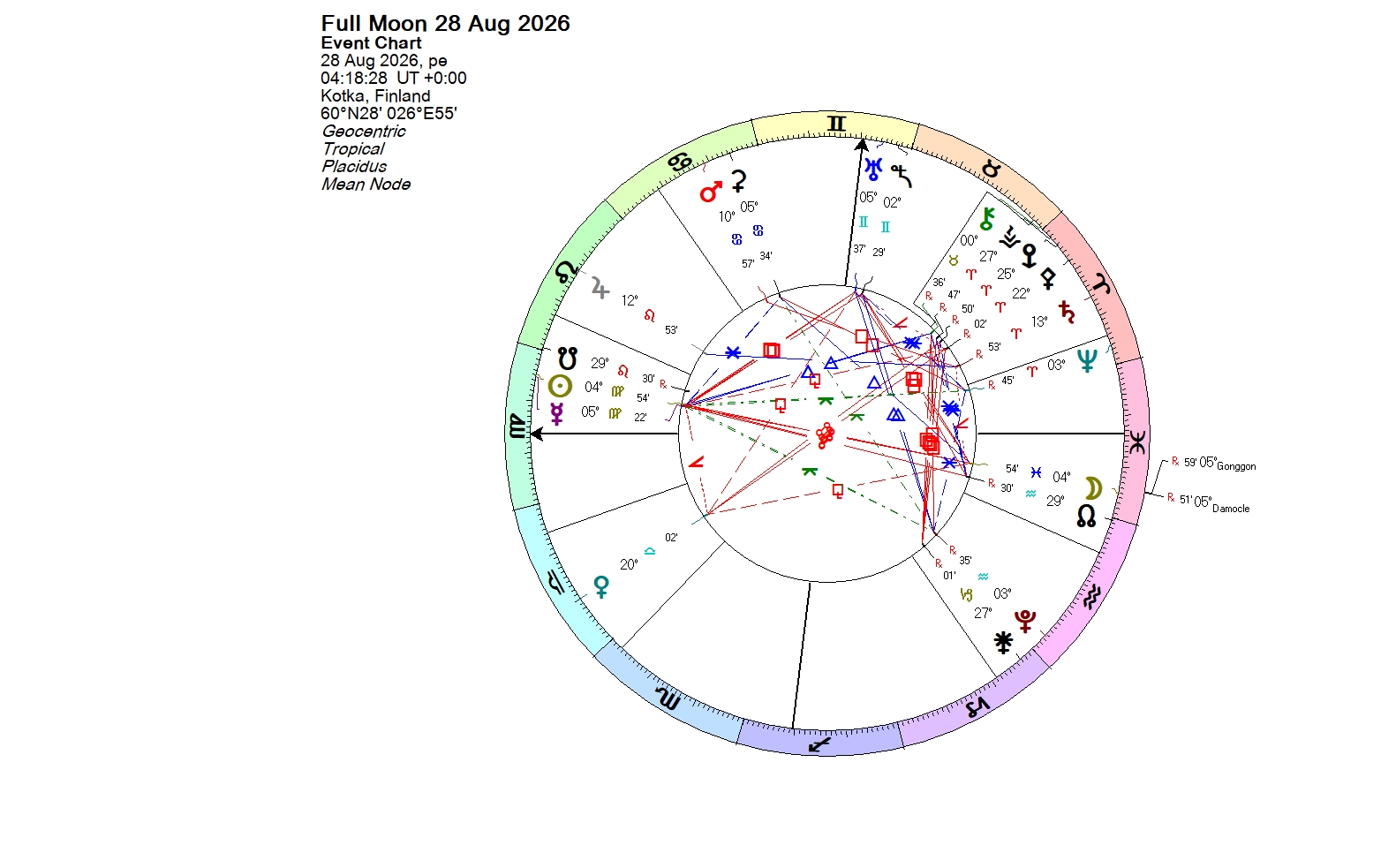
Thursday, August 27th, 2026The Full Moon in Pisces on Aug. 28, 2026, is a partial lunar eclipse. The Sun in Virgo is in conjunction with Mercury. Uranus in Gemini forms a t-square with the Sun and the Moon. The Moon in Pisces is in conjunction with Gonggong and Damocles.
Gonggong is the fifth-largest known trans-Neptunian object after Pluto, Eris, Haumea and Makemake. It is approximately the size of Pluto’s moon Charon. It is a scattered disc object in a rare 3:10 orbital resonance with Neptune. There is only one confirmed object besides Gonggong in this rare resonance state. Gonggong has an atmosphere. It has a satellite.
Gonggong has tended to hide its true nature.
Gonggong was discovered in 2007 and it was long without an official name. At first, Mike Brown was not interested in naming it because he thought the object was not noteworthy and interesting enough. The discoverers nicknamed the object “Snow White” for its presumed white color. However, it turned out to be very red.
In 2019, the discoverers hosted an online poll for the general public to choose between three possible names: Gonggong (Chinese), Holle (German), and Vili (Norse). Objects like Gonggong must be given names related to mythological figures that are associated with creation. The winning name was Gonggong from Chinese mythology. Gonggong is a water god with red hair and a serpent-like tail. He is known for creating chaos, causing flooding, and tilting the Earth.
I have never been comfortable with the name Gonggong. There were rumors that someone had manipulated the poll by using a vote spamming bot. Even if this is not true, I find it hard to see Gonggong as a creation deity, even though by tilting the Earth he created the change of the seasons. Rather, he is described as destructive.
In Norse mythology Vili and Ve are Odin’s brothers, and together the three created the cosmos. Some say that they actually represent the same entity, the threefold form of Odin. The name Vili means “will”, the conscious intention, which is also needed in the creative process. At this lunar eclipse we can purposely choose to move forward as our authentic selves.
The centaur-like Damocles was discovered in 1991 on an orbit that was completely different from all others known. The orbit reaches from inside Mars to outside Uranus. Damocles is now the namesake of a group of objects, the damocloids. Damocloids are believed to be inactive nuclei of long-period and Halley-type comets that have lost their volatile material and are dormant.
“The Sword of Damocles” is the metaphor for the imminent and ever-present peril faced by those in positions of power. It is often used also in a broader sense, and simply means an unexpected peril.
Damocles’s orbital period around the Sun is nearly 41 years. However, astrologically it spends most of it, around 30 years, in Aquarius, and then hurries through the rest of the eleven signs of the zodiac in about ten years. Damocles has recently started a new round and is now in early Pisces.
***
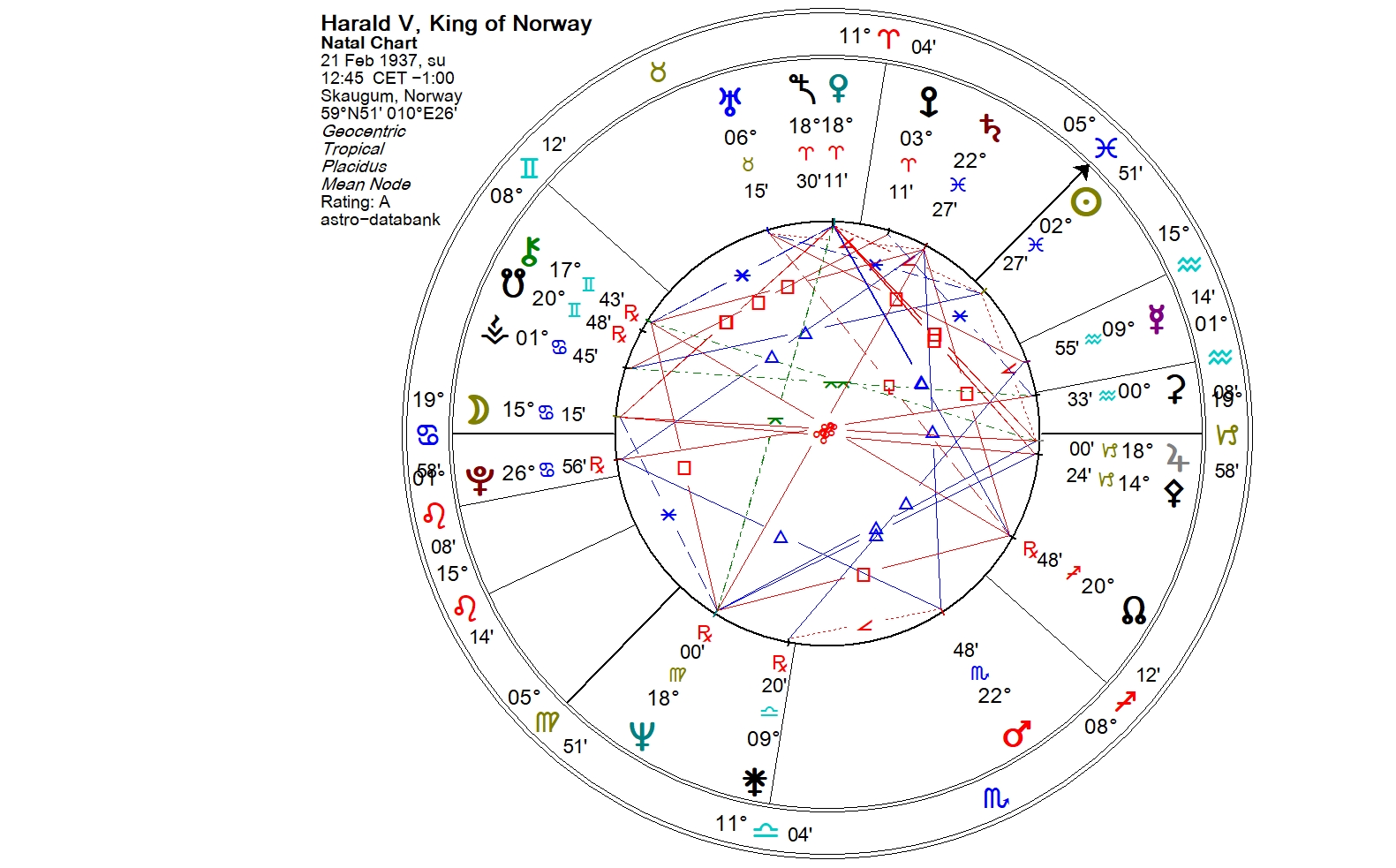
King Harald V of Norway, Europe’s oldest living monarch, is in an extremely serious condition in hospital in Oslo. He was hospitalized ten days ago and his condition has worsened. According to the doctors, it is necessary to prepare for the worst. The members of the royal family have gathered at the hospital.
The lunar eclipse is transiting King Harald’s Sun in early Pisces and his Midheaven at 5+ degrees of Pisces.