Archive for the ‘Full Moon’ Category

Full Moon in Virgo — March 05, 2015, 18:05 UT

Saturday, March 7th, 2015

The Moon was full in Virgo on March 5, 2015. In the opposing sign Pisces, the Sun was in conjunction with two minor planets, Chiron and Borasisi. Chiron has been called the rainbow bridge. In conjunction with the Moon was asteroid Iris, named after the personification of the rainbow.

7 Iris was discovered in 1847. It is one of those early asteroids which were considered planets at the time of their discovery. The rapidly growing number of bodies between Mars and Jupiter led to their reclassification as asteroids by 1854. Iris is bright and quite large. It is the fourth brightest object in the asteroid belt, and with about 200 km wide diameter, almost as big as Chiron.

In mythology Iris is the personification of the rainbow and messenger of the gods, particularly Hera. She is a female equivalent to Hermes and Mercury. Iris is often represented as a young maiden with golden wings on her shoulders and a caduceus in her hands. She travels with the speed of the wind, connecting gods and mortals. She is a guide and adviser, and her presence can be seen as a sign of hope.

Chiron was the first centaur planet discovered (in 1977). Astrologically Chiron is a symbol of healing and transformation. The healing is usually achieved through some amount of pain. Chiron raises awareness, whereas Borasisi tends to blur it.

66652 Borasisi is a binary Kuiper belt object discovered in 1999. The companion is named Pabu. The names come from a fictional creation myth told by Kurt Vonnegut in his novel Cat’s Cradle.

Quoting Vonnegut, “Borasisi, the sun, held Pabu, the moon, in his arms and hoped that Pabu would bear him a fiery child. But poor Pabu gave birth to children that were cold, that did not burn; and Borasisi threw them away in disgust. These were the planets, who circled their terrible father at a safe distance. Then poor Pabu herself was cast away, and she went to live with her favorite child, which was Earth.”

In the novel, the fictional religion of Bokononism is based on lies. One who believes harmless untruths will have peace of mind and a happy life.

The sign Virgo is associated with tendency to discriminate and prioritize. Be careful what you throw away from your life just now. Take notice of Iris’s subtle advice.

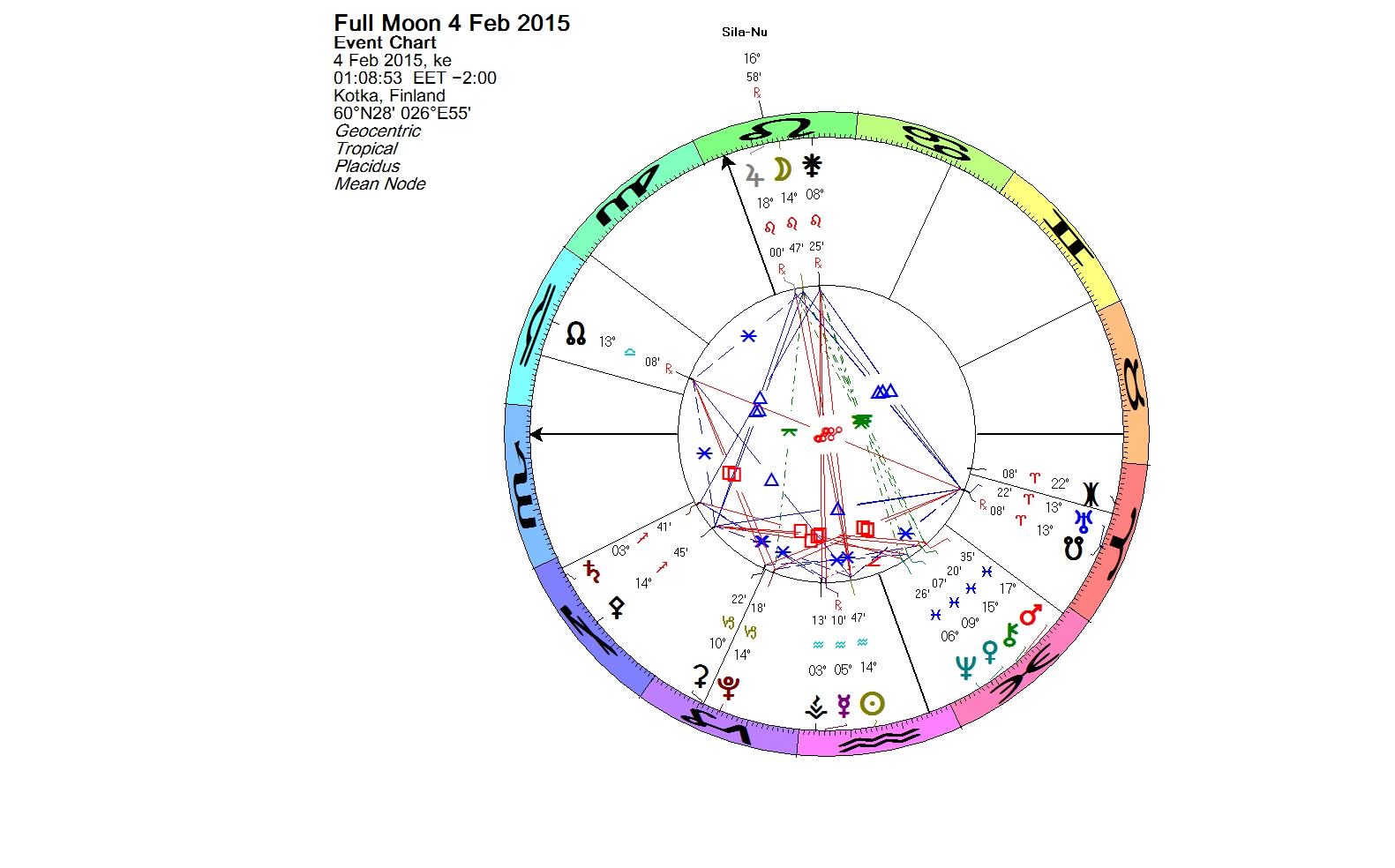
Full Moon in Leo — February 3, 2015, 23:09 UT

Wednesday, February 4th, 2015

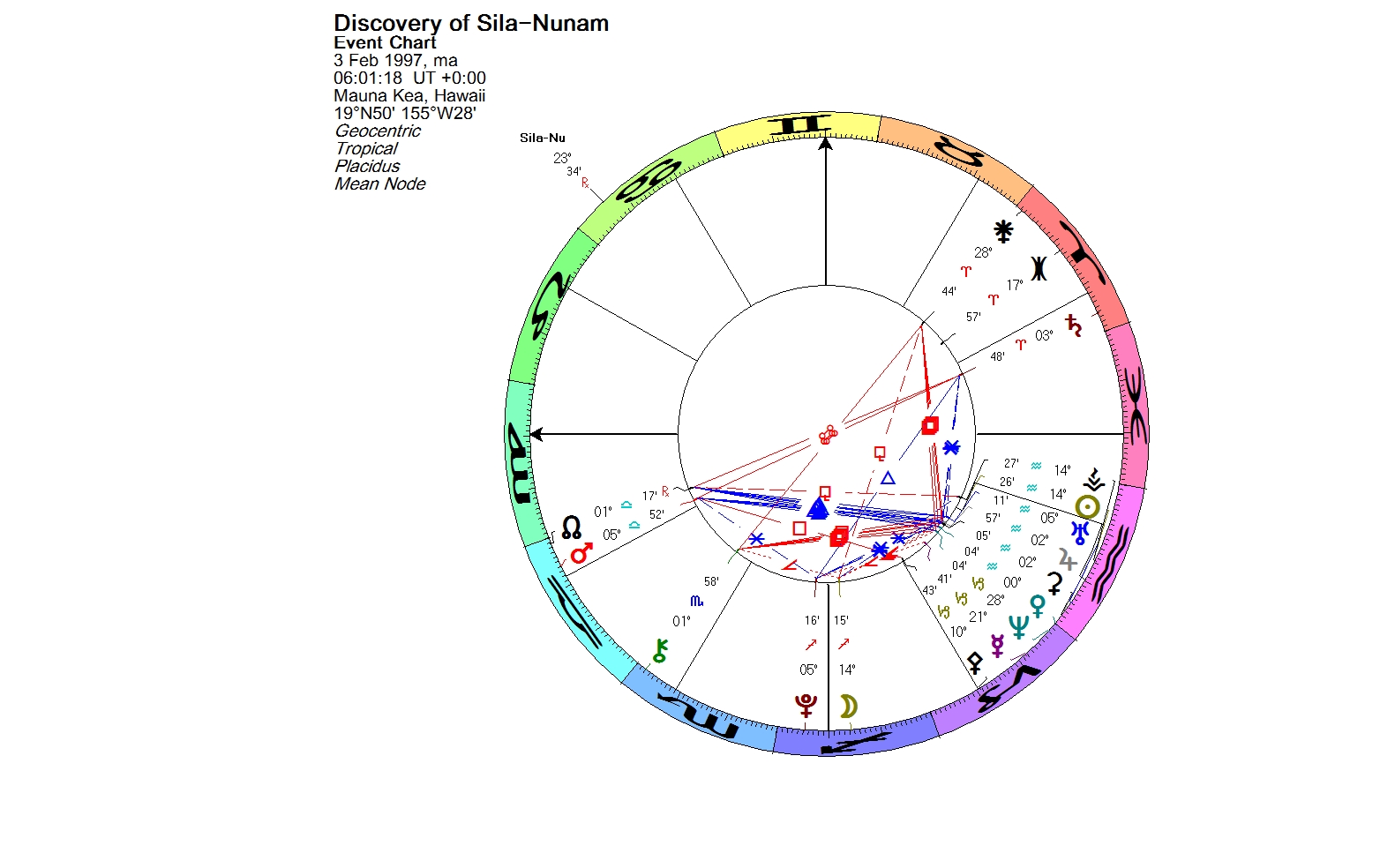
79360 Sila-Nunam was discovered exactly eighteen years ago at Mauna Kea, Hawaii, by Jane X. Luu, David C. Jewitt, Chad Trujillo, and Jun Chen.

Yesterday’s Full Moon in Leo was in conjunction with Jupiter and Sila-Nunam. The principle of Jupiter is growth and expansion. If Jupiter touches another planet in the chart by an aspect, the effect of that other planet tends to expand.

Sila-Nunam is a so-called cubewano, a classical Kuiper belt object with an orbital period of little over 291 years. It is a binary system. The two components are so close in size that they may be thought of as a double cubewano. The naming of the system took place three years ago, in January 2012.

All classical trans-Neptunian objects are given mythological names associated with creation. Sila and Nunam are Inuit deities. Sila is the Inuit god of the sky, weather, and life force. Nunam is the Earth goddess, Sila’s wife. Nunam created the land animals and, in some traditions, the Inuit people. Sila breathed life into the Inuit.

Sila or Silla is one of the oldest Inuit deities, even older than Sedna. He is thought to be formless and not to have many personality characteristics. Maybe that is why it is not easy to get grasp of the astrological meaning of this object named after him. As Silla is a deity of the sky, the wind, and weather, Sila-Nunam could possibly be used as one of the weather asteroids. I think the meaning should go deeper though than just an occasional winter storm or a snowfall, because Silla was a mighty creation god. The Inuit believed that Silla was the primary component of everything that exists. He had control over everything in one’s life.

The global weather on planet Earth is changing. The global warming affects us all: people, as well as animals and plants. In 1997, the same year when Sila-Nunam was discovered, an international treaty known as the Kyoto Protocol was adopted. The agreement set targets for industrialized countries to cut their greenhouse gas emissions. The agreement entered into force in 2005.The Protocol’s first commitment period started in 2008 and ended in 2012.

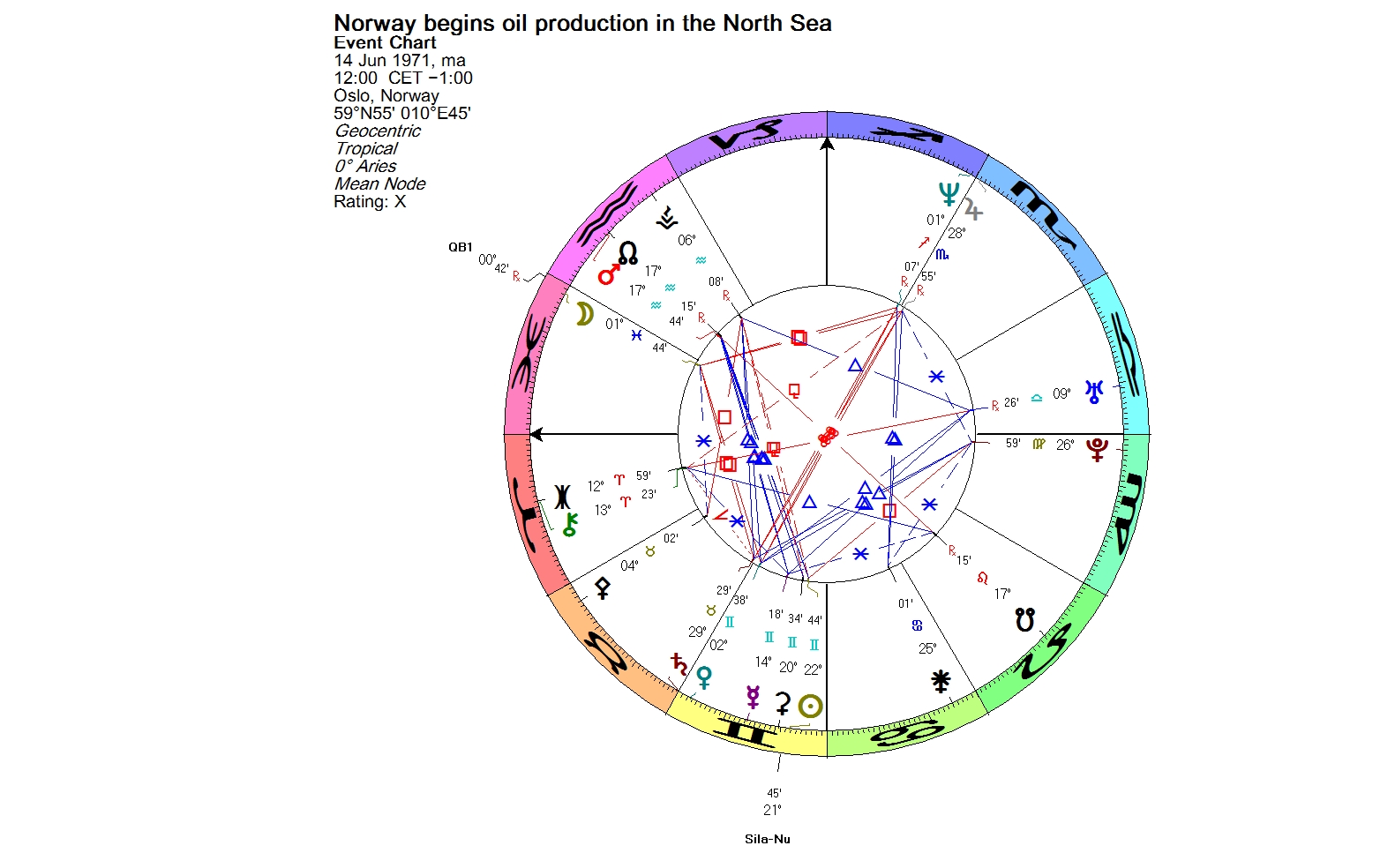
Many scientists say that the targets set in Kiyoto are too low. The global warming cannot be stopped anymore. Oil and gas production is the major source of greenhouse gas emissions. Planet Neptune and the Pisces sign are the astrological indicators of oil, gas, and oil fields. When Norway began oil production in the North Sea on June 14, 1971, Jupiter (the magnifier) was in conjunction with Neptune. 1992 QB1 (the trailblazer) had entered Pisces a few months earlier and was in the first degree of the sign, where the energy is fresh. The Sun was in conjunction with Sila-Nunam.

Today big oil companies are racing towards the Arctic, the region where the Inuit live. The Arctic holds some of the world’s largest unexploited oil reserves. Arctic oil drilling could have disastrous effects on the vulnerable environment and on the global climate. The risk is too high, as the spill cleanup is impossible in icy conditions.

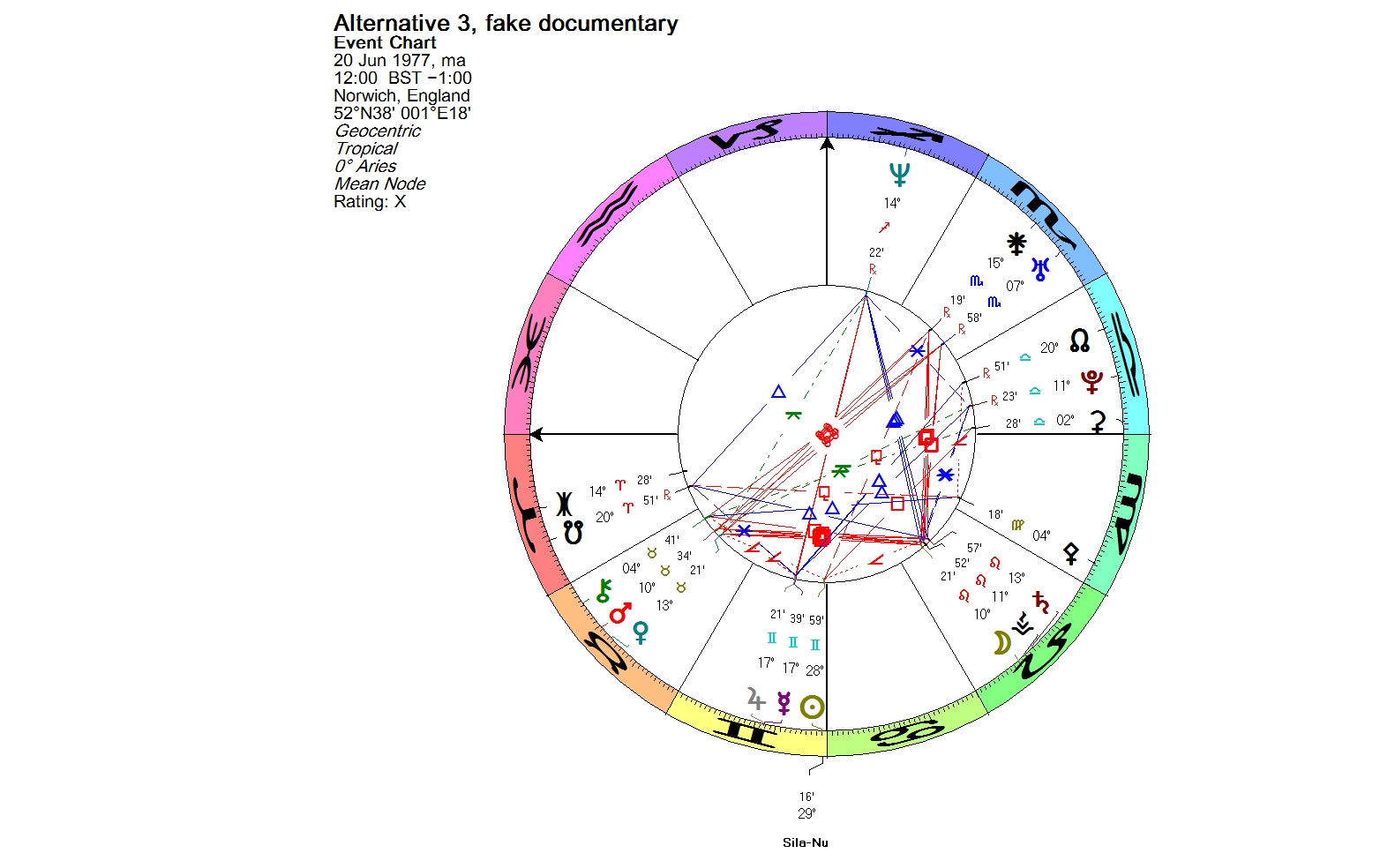
On June 20, 1977, the Sun made its yearly conjunction to Sila-Nunam. Anglia Television in the United Kingdom broadcast a fictional documentary known as Alternative 3. The public’s reaction was almost similar as to Orson Welles’s famous radio drama in 1938. Anglia Television was flooded with telephone calls demanding more information.

The episode had begun by reporting mysterious disappearances of physicists, engineers and astronomers. According to the research presented in the programme, the missing scientists were involved in a secret plan in outer space. The scientists had determined that the Earth was not able to support life for much longer, due to pollution which was causing a catastrophic climate change. There were three alternatives to the problem. The first one was a reduction of the human population. The second was to construct vast underground shelters for people until the climate would be stabilized. The third alternative was to populate Mars via a way station on the Moon.

In reality there is no Alternative 3. Our best option is to reduce pollution. The global warming may not be stopped, but it can be delayed. We need to conserve the life force of the Earth.

Full Moon in Aries / Total Lunar Eclipse — October 8, 2014, 10:51 UT

Wednesday, October 8th, 2014

The Full Moon of October in Aries is also a total lunar eclipse. It is best seen from the Pacific Ocean and bordering regions. The eclipse occurs two days after perigee, and although according to the original definition of a supermoon by astrologer Richard Nolle, this one does not quite count as a supermoon, the Moon will appear big. When a total lunar eclipse happens, the Moon is still visible but has a reddish color. That is why a total lunar eclipse is sometimes referred to as a blood moon.

Eclipses can feel shaky, and this one may seem a bit ominous. But I agree with astrologer Jonathan Cainer, who wrote: “This blood moon eclipse restores light to your heart.”

The Moon is in Aries. Mars, the ruler of Aries, is in conjunction with 174567 Varda, a trans-Neptunian minor planet named after a deity in J. R. R. Tolkien’s legendarium. The Mars-Varda conjunction is in flowing trine to the Moon and sextile (which is another “easy” aspect) to the Sun.

174567 Varda is highly likely to be a dwarf planet. It was discovered in 2003 by Jeffrey A. Larsen, but the precovery images go back to 1980. The name was announced in January 2014. 174567 Varda has a large moon, which is named after Varda’s handmaiden in Tolkien’s mythology, Ilmarë.

Varda is the Queen of the Stars, the Lady of Light. She made the stars and constellations, and she established the courses of the Moon and the Sun. “In light is her power and her joy,” wrote Tolkien. She is said to be too beautiful for words, and her face radiates light.

In the eclipse chart the Moon-Uranus conjunction in Aries, the Mars-Varda conjunction in Sagittarius, and Jupiter (“the greater benefic”) in Leo, are forming a grand trine in Fire. When we add the Sun in Libra (the sign associated with peace, love and harmony) to the configuration, we get an aspect pattern called a kite. The opposition of the Sun and the Moon forms the spine, and the Sun is the apex of the kite.

The kite flies towards the light.

Full Moon in Capricorn — July 12, 2014, 11:25 UT

Saturday, July 12th, 2014

”You are the queen and king combining everything
Intertwining like a ring around the finger of a girl
I’m just a singer, you’re the world
All I can bring ya
Is the language of a lover
Bella luna, my beautiful, beautiful moon
How you swoon me like no other”

– Bella Luna, Jason Mraz

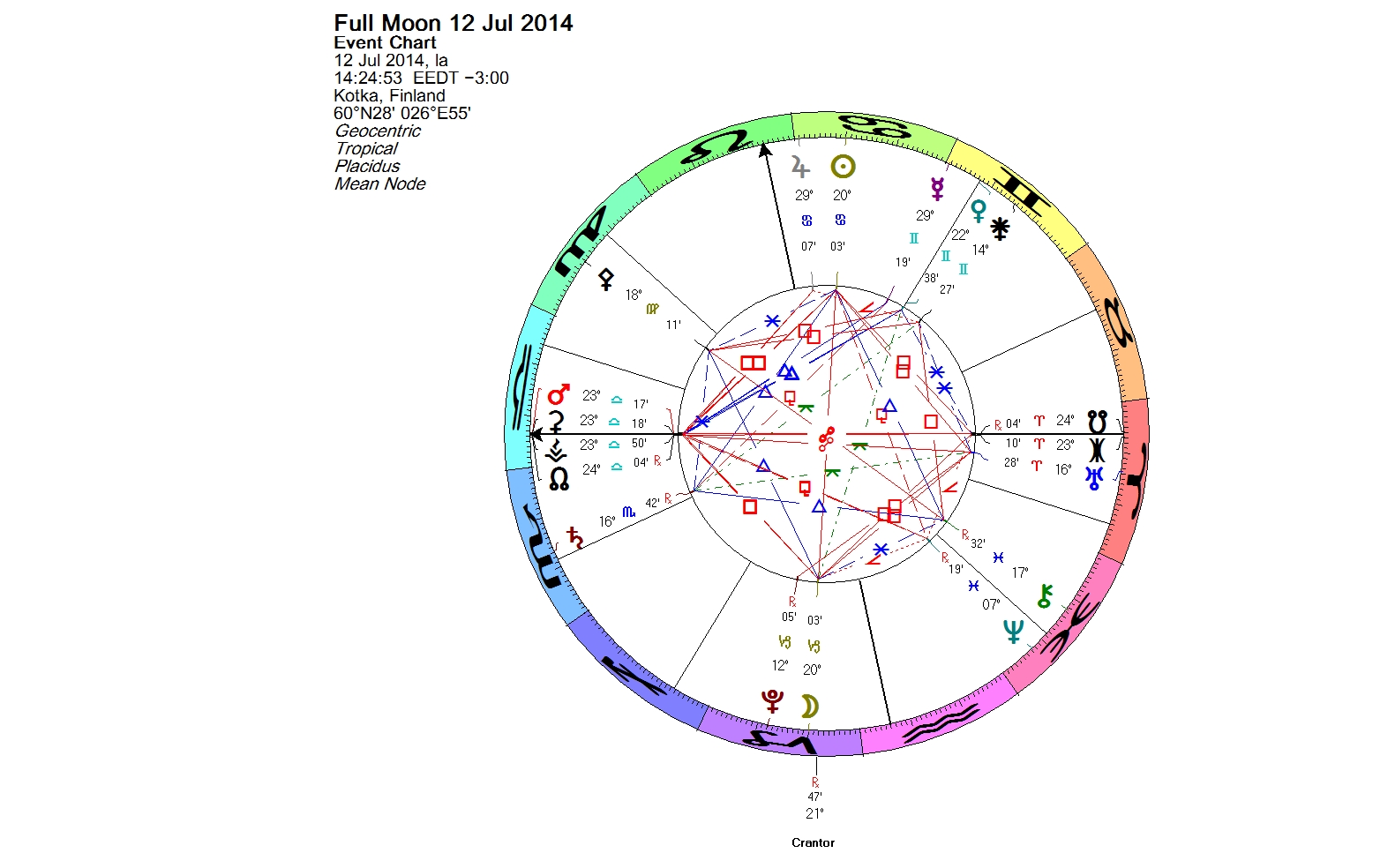
Today is the Full Moon. This is a supermoon in Capricorn, and if you happen to be looking at the horizon just when the Moon is rising above it, you may get a spectacular view of the Moon looking super big and bright. We are also in the midst of the times, when unpredictable events may occur, as the Moon is in conjunction with the centaur planet Crantor, a co-orbital of Uranus.

Astronomers call the supermoon phenomenon “perigee moon.” The Moon’s orbit around the Earth is elliptical, and as a consequence the apparent size of the Moon varies. Now the Moon is near to the Earth at its perigee, and the Earth, the Moon and the Sun are all in a line. Also the two following Full Moons (Aug. 10 and Sept. 9) will be supermoons.

In the Full Moon chart cast for Kotka, Finland (my home town), the Libra ascendant is placed right in the middle of a grouping consisting of Mars, Ceres, Vesta and the North node of the Moon. The Sun and the Moon are squaring this grouping. In Aries, Eris is opposing it, so we are actually witnessing a grand cross formed by these planets.

Just a few days ago (on July 5) we were able to see in the sky another super event worth mentioning, a close conjunction of Ceres and Vesta. Not since their discovery more than 200 years ago had anyone been able to observe those two asteroids to appear so close together. Ceres (discovered in 1801) is the biggest asteroid of the main belt, whereas Vesta (discovered in 1807) is the brightest. They will remain near one another for the next few weeks.

Astrologically Ceres symbolizes the need to nurture others. Vesta has affinities with Saturn, the ruler of the current Moon sign Capricorn. Vesta can represent dedication and commitment to work. Mars pushes us into action. When these three are combined, we can easily get absorbed in our duties and forget to relax. So, take time for yourself tonight and watch the Bella Luna!

Full Moon in Scorpio — May 14, 2014, 19:16 UT

Thursday, May 15th, 2014

The Scorpio Full Moon – the opposition of the Sun and the Moon in Taurus-Scorpio – aligned with Sedna in Taurus. Sedna, named in honor of the Inuit goddess of the sea, is one of the most peculiar minor planets in our solar system.

The Moon in Scorpio is passionate. The Venus-Uranus conjunction in Aries is reckless and fearless. The transformative Pluto in Capricorn is squaring the conjunction. Note, that Venus and Pluto are the rulers of Taurus and Scorpio, the signs currently occupied by the luminaries.

As my friend, astrologer Len Wallick, reminded me today, this Full Moon in Scorpio combines with the Water trine formed by Huya, Salacia and Varuna, which was exact earlier this year. The January Full Moon was conjunct Varuna in Cancer, and yesterday the Moon fell in another water sign, Scorpio, conjunct Huya. All three are minor planets named after water deities from mythologies from different parts of the world. The excessive amount of water means copious feelings.

The discovery of Sedna was announced ten years ago. Sedna is one of the most distant objects of our solar system. The origin of Sedna is still a mystery. Has it been captured from another star system, or was it tugged into its current orbit by a passing star? Astronomer Mike Brown believes Sedna to be the most scientifically important trans-Neptunian object found to date, because understanding its unusual orbit is likely to yield valuable information about the early evolution of the solar system. In March it was announced that another icy minor planet in Sedna’s region has been found, 2012 VP113. Chad Trujillo, a co-discoverer of the new object, said: “We’re starting to get a taste of what’s out beyond what we consider the edge.”

Sedna’s orbit around the Sun is exceptionally long and elongated, and the orbital period is approximately 11,400 years. In an astrological chart Sedna works almost like a fixed star. Sedna is nearing its perihelion, the point where it is nearest to the Sun, in 2076. The last time it was this close to the Sun, Earth was just coming out of the last ice age.

The story of Sedna is loaded with deep feelings, including disappointment and anger. It is also full of promise and hope. Sedna was a beautiful young Inuit girl who had many suitors. She and her family were starving. One day a hunter came and said that if he could have Sedna, he would give her father fish in return. Sedna’s father agreed. The hunter was really a birdman who took Sedna to a big nest on a cliff where she had nothing else but rotten fish to eat. Sedna cried for her father to take her back, so he came to rescue her, but the birdman caused a terrible storm which nearly sunk their kayak. In desperation, Sedna’s father threw her into the cold raging sea. Sedna tried to hold on to the boat, but he chopped off her fingers, which became seals, whales and other marine animals. Sedna descended into the depths of the Arctic Ocean and became the mighty queen of the underworld.

Sedna must be treated with respect, otherwise she sends storms and starvation to the humans. Then a shaman must overcome his fear and visit Sedna in the deep waters, comb her tangled hair and calm her down again. When Sedna is happy, she releases her mammals and allows the starving humans to eat from the bounty of the sea.

Some similarities can be noted between the discovery chart of Sedna and the Scorpio Full Moon chart of yesterday. Sedna was discovered on Nov. 14, 2003. The Sun was in Scorpio, opposite Sedna, whereas now it is in Taurus conjunct Sedna. We have just recently been witnessing the Grand cross pattern formed by Mars, Jupiter, Uranus and Pluto. In yesterday’s chart Venus was tightly squaring Pluto. At the time Sedna was discovered, Mars, Jupiter and Venus were forming a t-square, and Venus was in conjunction with Pluto. So we can expect to encounter some similar energies or phenomena in our lives as when Sedna was found.

I was welcoming this watery, passionate Scorpio Full Moon spending hours at the water’s edge, watching boats, windmills and the sea. A sailing boat was launched, and a ship was coming in. A new journey is about to begin.

Full Moon in Virgo — March 16, 2014, 17:08 UT

Tuesday, March 18th, 2014

The Full Moon in Virgo on March 16, 2014, conjoined a trans-Neptunian minor planet named Logos. This proved to be a Logian moment, as on the following day the media announced a spectacular discovery: the scientists have found the signal left in the sky by the rapid expansion of space that occurred just fractions of a second after the Big Bang.

Heraclitus (ca. 535 – 475 BCE), a Greek philosopher, claimed that everything originates out of the logos.

58534 Logos is a binary object with an orbital period of almost 303 years. A binary planet consists of two objects that are similar in mass and orbit to one another. Each orbits the other around a gravitational balance point that is between the two. The point is called the center of mass, or the barycenter. The pair may have been born like twins, or may be produced by a collision, where a single body is split in two. The number of trans-Neptunian binaries (TNBs) with known mutual orbits has expanded fast in recent years.

58534 Logos was discovered in 1997 and its binary companion Zoe in 2001. The name of the pair comes from the creation myth of the gnostic traditions. The Greek word logos is commonly translated as “word”, but it can mean “speech”, “plan”, “formula”, “account”, and “reason”. Ancient philosophers used the term in different ways. The name Zoe means “life”.

Heraclitus established the term logos in Western philosophy. His main doctrine was the unity of opposites. He thought that all things are composed of opposites, and because the opposites are at strife with one another, all things are in constant change. The change is governed by logos, a principle of order.

In English, the word logos is the root of “log” (as in record) and of “logic.” Logic is a special area of philosophy and it has many branches. In ancient times the motivation for the study of logic was to learn to distinguish good arguments from bad ones, and to become more effective in argument. Logic is the essence of critical thinking, which is not necessarily anything critical in the negative sense of the word. Critical thinking is the ability to think clearly and rationally. It enables one to analyze, evaluate, and restructure one’s thinking. Fair-minded critical thinking requires intellectual humility, empathy, integrity, courage and other intellectual traits. Critical thinking without these traits may result in clever, but manipulative thought serving unethical purposes.

In later times formal logic has been studied in the context of mathematics. The development of formal logic and its implementation in computing machinery is the foundation of computer science. Computers can be used as tools for logicians, and logic is essential for scientists.

The following persons have a Sun-Logos conjunction in their chart:

Rene Descartes (March 31, 1596 – Feb. 11, 1650) was a French philosopher, mathematician, and writer. He is credited as “the father of modern philosophy”. Analytic geometry, the bridge between algebra and geometry, has been attributed to Descartes. He is also regarded as the first thinker to emphasize the use of reason to develop the natural sciences. Descartes had a Sun-Logos conjunction in Aries.

According to a study carried out in Helsinki in 2013, Esko Valtaoja (June 20, 1951 – ) is the most notable Finnish scientist. He is an astronomer and writer, who works as a professor at the University of Turku. He has ability to present complex scientific theories in a manner that is both understandable and entertaining to the general audience. Esko Valtaoja has a tight Sun-Logos conjunction in Gemini.

Louis Braille (Jan. 4, 1809 – Jan. 6, 1852) was a French educator and inventor of a system of reading and writing for use by the blind, known worldwide as braille. The system consists of a code of small raised dots that can be felt on paper. Louis Braille himself had gone blind in his childhood. Braille’s Sun-Logos conjunction was in Capricorn.

Thomas Alva Edison (Feb. 11, 1847 – Oct. 18, 1931), the American inventor, who patented over a thousand inventions, had a triple conjunction of the Sun, Mercury and Logos in Aquarius. He was one of the first inventors to apply the principles of mass production and large-scale teamwork to the process of invention. In his youth, before his career as an inventor and a businessman, Edison was a telegraph operator.

Galileo Galilei (Feb. 15, 1564 – Jan. 8, 1642), the Italian physicist, mathematician, astronomer, and philosopher, has been called the “father of science”. Galileo was one of the first modern thinkers to clearly state that the laws of nature are mathematical. He wrote: “Philosophy is written in this grand book, the universe… It is written in the language of mathematics, and its characters are triangles, circles, and other geometric figures.” Galileo’s Sun-Logos conjunction was in Pisces.

Another scientist with the Sun-Logos conjunction in Pisces, was Albert Einstein (March 14, 1879 – Apr.18, 1955). His name has been synonymous with genius. He developed the general theory of relativity. Einstein also came up with the idea of gravitational waves, the subject of the sensational science news in the last couple of days. He predicted that violent events should trigger gravitational waves, which would set space rippling. Direct evidence to prove his theory has been missing so far. The astounding findings, which were announced just after the Virgo Full Moon, are offering the first direct evidence of those waves.

Full Moon in Cancer — January 16, 2014, 04:52 UT

Saturday, January 18th, 2014

The Full Moon of January took place in Cancer, one of the three water signs of the zodiac, and the home sign of the Moon. In the background of the dynamic aspects and main operators of the present chart is a more subtle influence, a precise Grand trine in Water, formed by three distant minor planets. All three objects are named after water deities from mythologies from different parts of the world. What is remarkable about this current Grand trine is that because of the long orbits of the objects in question, this is the first Grand trine in Water formed by these particular objects during the Common Era.

The three occupants are Varuna, Salacia and Huya. All three are trans-Neptunian objects, and big enough to be probable dwarf planets. The Full Moon appeared in one of the corners of the rare Grand trine, at 25+ degrees of Cancer, in exact conjunction with Varuna, to the degree. Varuna has the longest orbital period of the three, Salacia is the biggest of them, and Huya’s orbit goes furthest away from the Sun.

38628 Huya is a plutino and has got the shortest orbital period of the three trans-Neptunian objects in question, nearly 248 years. Like Pluto, Huya spends part of its orbit closer to the Sun than the planet Neptune. Currently Huya is inside the orbit of Neptune. It will come to perihelion, the point in its orbit where it is nearest to the Sun, in December 2014, at 27+ degrees of Scorpio.

Huya was discovered in March 2000 in Venezuela, and afterwards has been found in pre-discovery images dating back to 1996. Huya was named after Juyá, the rain god of the indigenous Wayuu people of Venezuela and Colombia. In 2012 Huya was discovered to have a satellite. The binary companion has not been named yet.

20000 Varuna is named after an important ancient Hindu deity. Varuna presided over the waters of the heaven and of the ocean and was the guardian of immortality. He rode on a mythic sea creature, a crocodile named Makara. Varuna is the god of all forms of the water element, particularly the oceans, and he can be identified with Greek Poseidon and Roman Neptune.

20000 Varuna was discovered in November 2000. The precovery images are from 1953. It is a cubewano on a near circular orbit around the Sun. The orbital period is approximately 281 years. Varuna has a rapid rotational period of approximately 6.34 hours. This is rare for objects as big as Varuna, suggesting that its shape is elongated.

120347 Salacia is one of the largest objects in the Kuiper belt, over 900 km in diameter. This cubewano was discovered in September 2004. A couple of years later its tiny companion Actaea was found. Together they form a binary system. From the total mass of the system, Salacia’s portion is about 96 percent. The orbital period around the Sun is approximately 274 years.

In Roman mythology Salacia was the goddess of salt water and the wife of Neptune. She was also ruling over the springs of highly mineralized waters. Actaea got her name from one of the Nereids, the sea nymphs who accompanied Poseidon. Those friendly mermaids are helpful to sailors plowing through the stormy seas.

Because of the long orbits and slow motion of these objects, Varuna and Salacia have been forming trine in Cancer and Pisces already twenty years.

The water element represents emotions, feelings and the unconscious. The trine aspect provides vision and ideas. The Sun represents purpose and will, expression, “the self”. The Sun means energy, and in the chart, the Sun in the midpoint of one side of the Grand trine, in the industrious sign of Capricorn, offers the point where the passive and static flow of the trine pattern has the opportunity to break outside and help us to put our visions into effect.

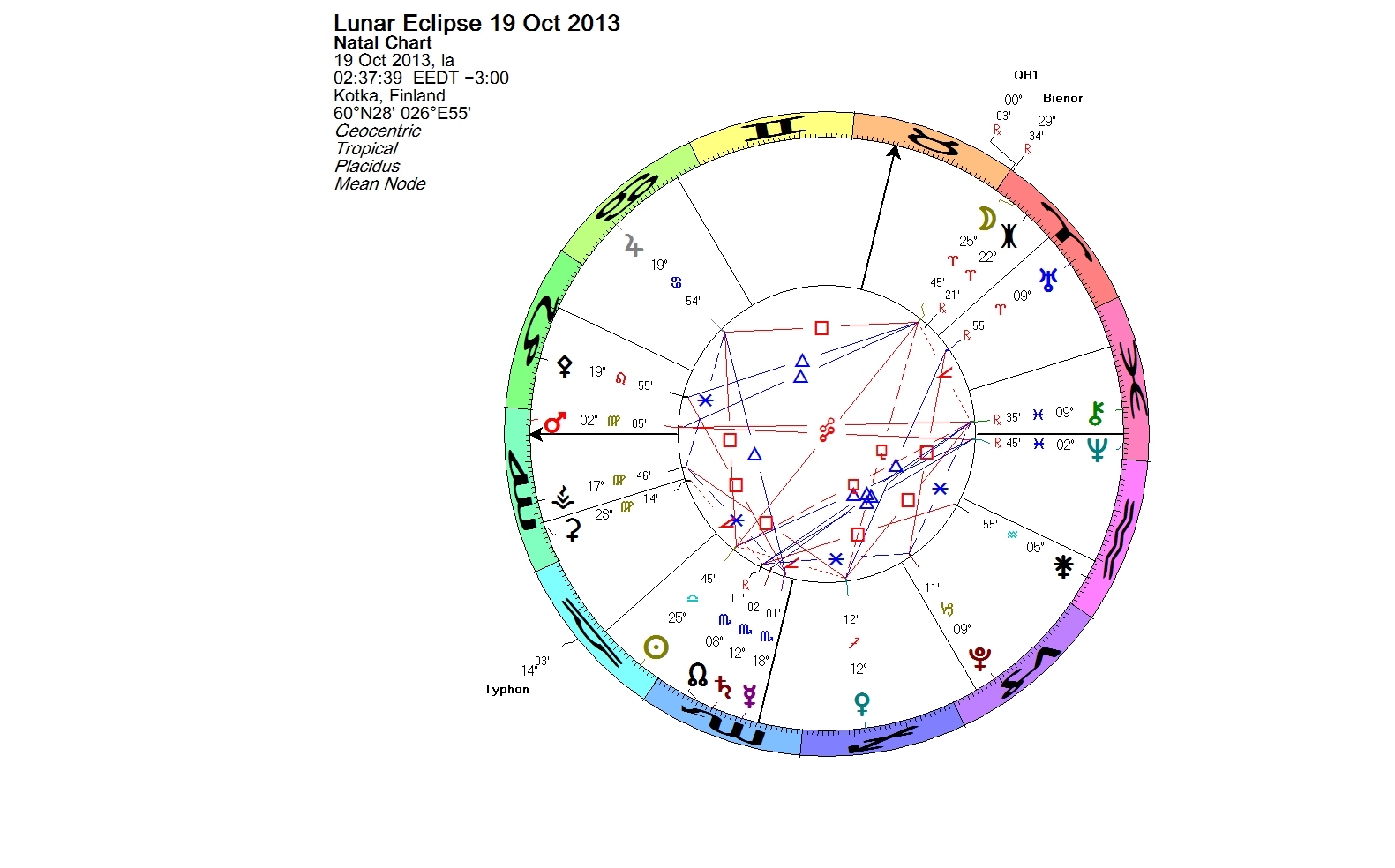
Full Moon in Aries / Penumbral Lunar Eclipse — October 18, 2013, 23:38 UT

Saturday, October 19th, 2013

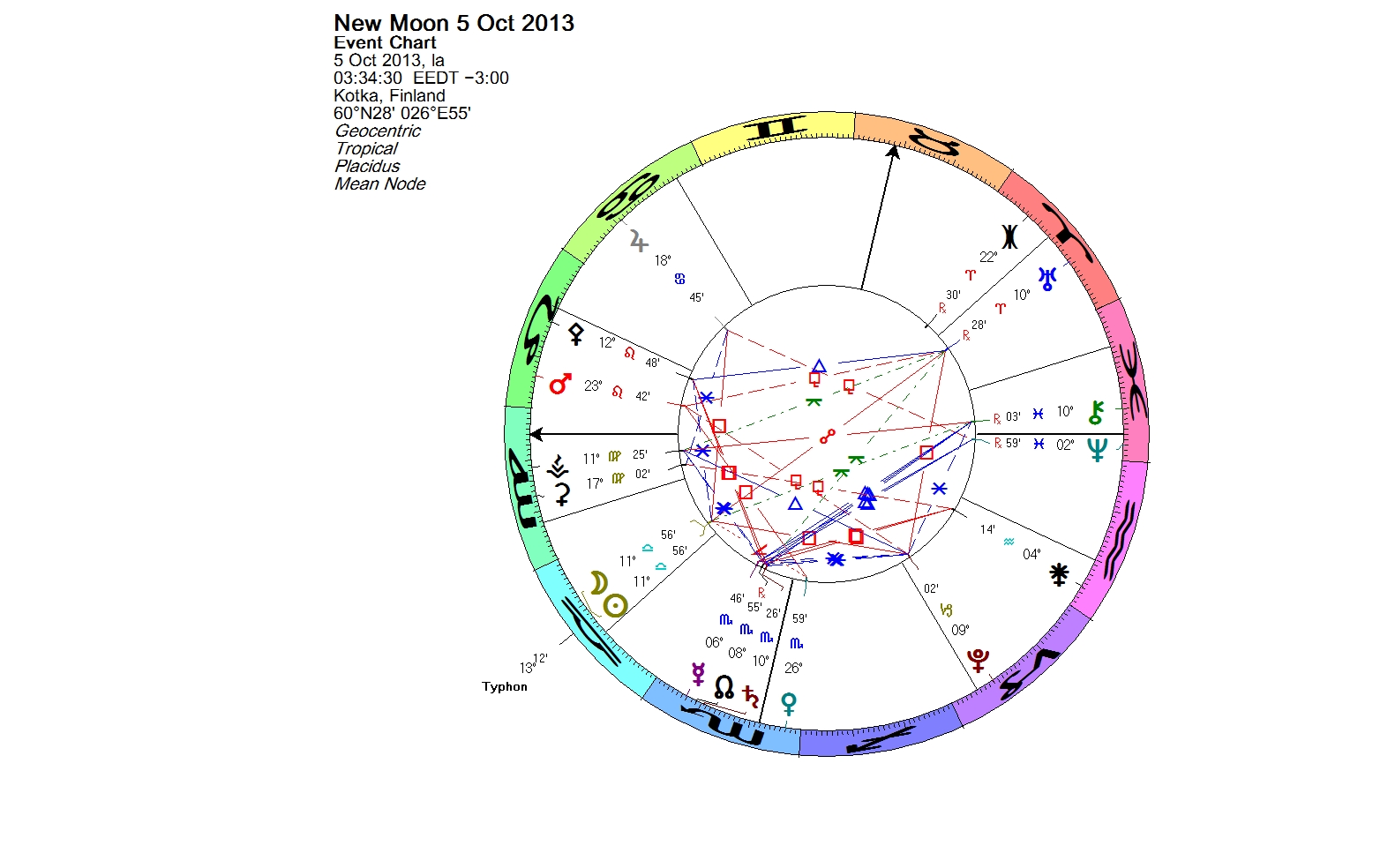
New Moon in Libra — October 5, 2013, 03:35 UT

The New Moon, the conjunction of the Sun and the Moon, starts the monthly lunation cycle. When the New Moon occurs in conjunction with a planet, the whole month ahead can be colored by the symbolism of that planet.

The New Moon on October 5 was conjoining Typhon, the namesake of the Greek mythological monster, whose name is considered to be a possible etymology for the word describing a tropical cyclone, typhoon. Since the Libra New Moon we have been reading about typhoons, cyclones and earthquakes emerging in different parts of the world. Even in Finland a giant white tornado, though not a natural phenomenon, but caused by an airplane, was seen in the sky and causing wonder. The shape of a spiral is characteristic for Typhon.

The scattered disc object 42355 Typhon was discovered in 2002. Typhon is considered the first known binary centaur, when using an extended definition of a centaur. The companion Echidna was identified in 2006. In Greek mythology Typhon was a terrible monster who was the source of destructive storm winds and volcanic eruptions. He was so huge that his head was said to brush the stars. He shot hot rocks and fire from his mouth. Typhon was trapped beneath Mount Etna in Sicily by Zeus. Echidna was his wife.

When typhoon Fitow made the landfall in China on October 7, 2013, soon after the Libra New Moon, the Sun and Typhon in Libra were in conjunction to the degree. Hundreds of thousands of people had been evacuated before the storm hit the coast. Fitow brought heavy rains, causing power cuts and travel chaos.

Then there was typhoon Nari impacting the Philippines and Vietnam.

Cyclone Phailin prompted India’s biggest evacuation in 23 years. According to hurricane researcher Brian McNoldy, “You really don’t get storms stronger than this anywhere in the world ever. This is the top of the barrel.” On October 12, 2013, Phailin made a landfall in Odesha as a very severe cyclonic storm. Because of the evacuation many lives were saved, but the material loss is massive. People have lost their homes and businesses. Around 12 million people may be affected.

On the same day, October 12, 2013, an earthquake caused panic in Greece. The Greeks are used to quakes, but this one was strong and lasted long. Fortunately, it did not cause any serious damage. The quake occurred near Crete and was felt also in Israel.

On October 15, 2013, a 7.2 magnitude earthquake shook the Philippines, killing more than 140 people and damaging buildings. The next day a powerful typhoon Wipha was threatening Japan. Luckily the storm weakened and passed the islands closely without causing any additional problems to the Fukushima nuclear plant.

Typhon creates ash clouds. We still have fresh in the memory the eruption of Eyjafjallajökull in Iceland in April 2010, which caused enormous disruption to air travel in Europe over a period of six days. The ash cloud covered large areas of northern Europe sky, and about 20 countries had to close their airspace. When the first small eruption started on March 20, 2010, the Sun was at the Aries point opposing Saturn. Only a week earlier the Sun had opposed Typhon, and then passed over Uranus. The second phase of the eruption started on April 14, 2010, at the New Moon. By then the Sun had travelled to a quincunx aspect to Typhon, crossing Eris (the goddess of disorder) on its way. The ash plume rose to a height of approximately 9 kilometers – like a monster whose head reaches the stars.

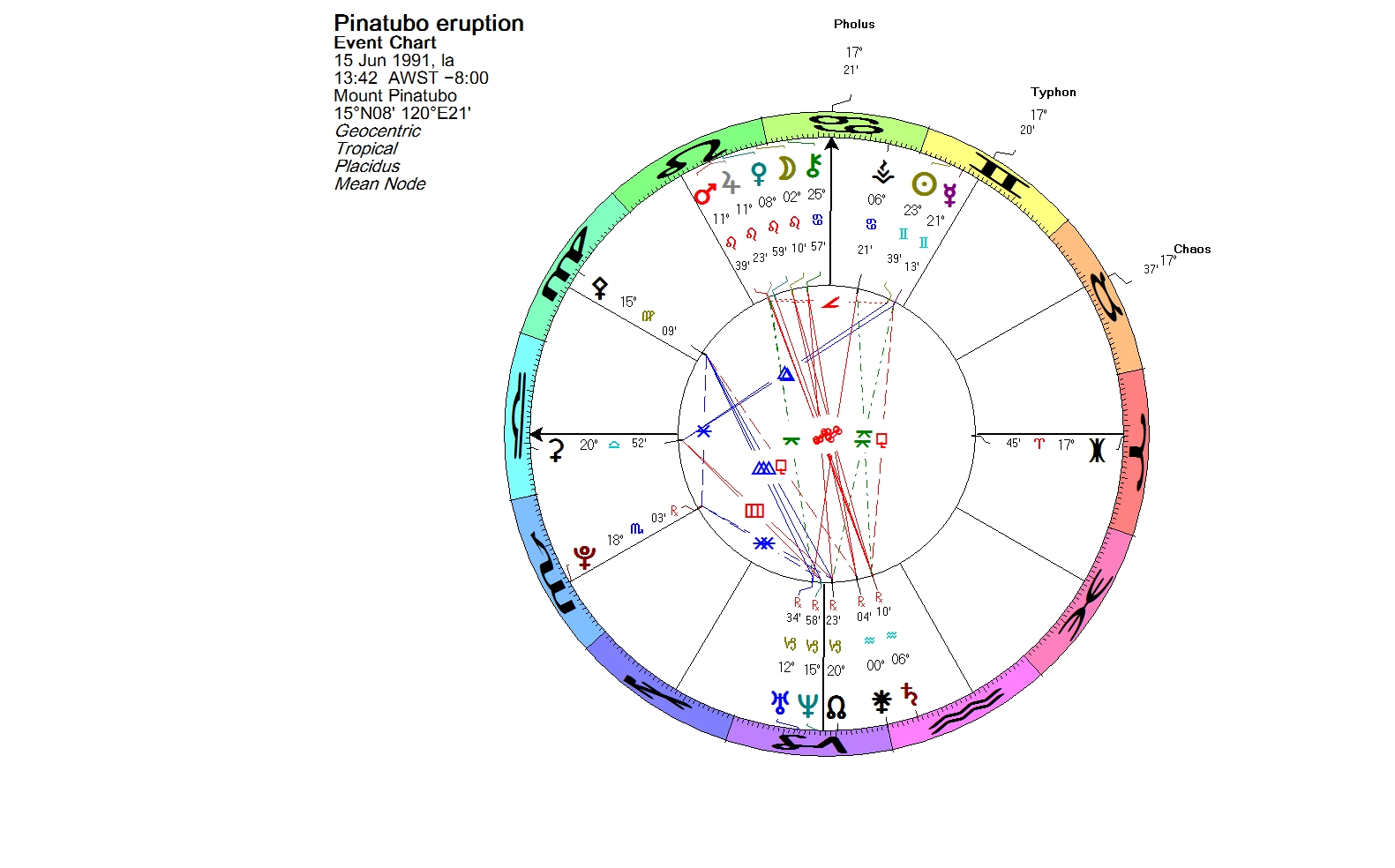
A typhoon making its landfall and one of the largest volcanic eruptions of the 20th century occurring at the same place on the same day is what happened in the Philippines on June 15, 1991. The conjunction of the Sun and Typhon was wide, but Typhon was also the focal point of a yod configuration formed by Pluto, Neptune and Typhon. In addition, Typhon was the midpoint of Pholus and Chaos, two other minor planets, which fit in the symbolism of that moment. The ash from the Mount Pinatubo eruption brought total darkness to the area. Typhoon Yunya’s rainfall mixed with the ash and formed a heavy blanket, which made roofs collapse. The effects of the eruption were felt worldwide, as the ashes reached high in the atmosphere.

Another event which happened when the Sun and Typhon were in conjunction was the Palm Sunday tornado outbreak in 1965. It is among the most intense tornado outbreaks ever recorded.

The Sun was squaring Typhon on July 9, 1958, when the largest known tsunami in modern times occurred in Alaska. Because of a big earthquake, a huge amount of rock and ice fell into the Lituya Bay and caused a wave of 516 meters in height. The event is known as the Lituya Bay megatsunami.

There has always been, and will continue to be floods, hurricanes and other extreme weather events. However, human activity like deforestation and burning fossil fuels causes global warming, which increases intense weather phenomena. Just around the New Moon the news told, how a wave of hundreds of small earthquakes has been worrying people in Spain, in an area which normally is not known for seismic activity. A link between the quakes and work on a big offshore gas storage plant is suspected. The plant aims to inject gas in a depleted oil reservoir under the Mediterranean Sea. The Spanish government has now suspended the work.

We feel helpless when facing the force of nature and natural disasters. There’s plenty we can do though as individuals and as part of our community. Not many of us have the courage to face a Russian prison, like Sini Saarela and other Greenpeace activists, for example. But it does not have to be something big, because our everyday choices count.

The first Earth Day celebrations on April 22, 1970, took place when the Sun was conjunct Typhon in the first degree of the earth sign Taurus. Now that degree is occupied by the conjunction of Bienor and 1992 QB1. Bienor can give us strength and initiative to challenge ourselves. The Aries Full Moon last night was a Lunar Eclipse in vicinity of Bienor, and eclipses are famous of their ability to move stuck energy and push us on a new path in life. This is a good time to start listen the Earth and take responsibility of its future, even in small ways.

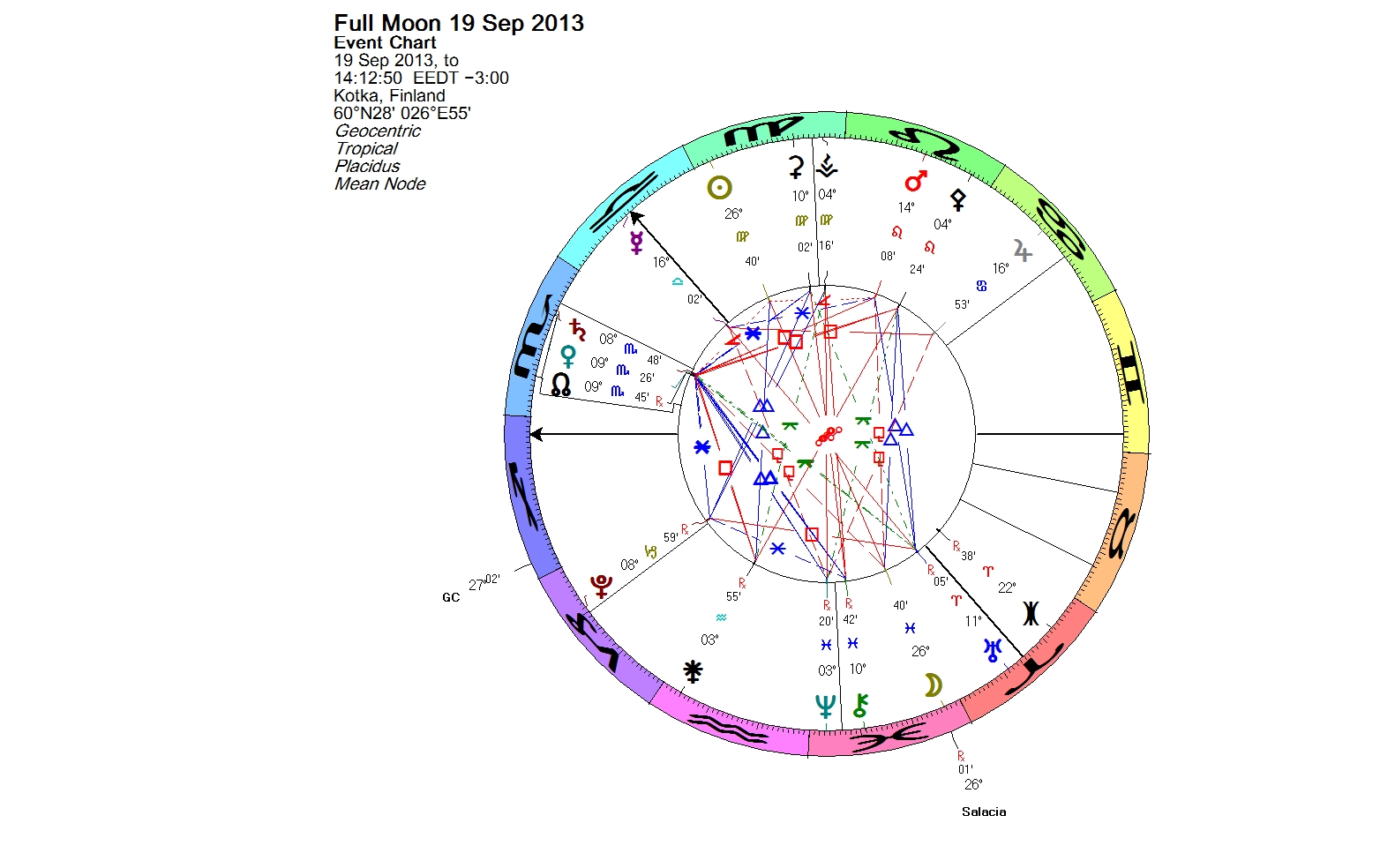
Full Moon in Pisces — September 19, 2013, 11:13 UT

Monday, September 23rd, 2013

Autumnal Equinox – September 22, 2013, 20:44 UT

Today is the Autumnal Equinox, one of the two days of the year, when the length of night and day is equal everywhere on Earth. No matter where on Earth we live, the one thing we all share every day of our lives is the ocean. There is only one global ocean, which covers about 70 percent of the Earth.

The Full Moon in Pisces last week occurred in exact conjunction with Salacia, a trans-Neptunian object named after the goddess of salt water, the wife of the sea god Neptune. According to some sources, Salacia was the personification of the calm and sunlit ocean. There are others, who say that Salacia represented the violent and gushing waters. In the news stream around the Full Moon, Salacia’s violent side has been noticeable.

120347 Salacia is a binary trans-Neptunian object discovered in 2004. The companion is named Actaea after a sea nymph. The recent study has shown, that Salacia is over 900 km in diameter (about same size as Ceres), setting it among the largest objects in the Kuiper belt.

In June 2011 Aquarius/SAC-D satellite was launched to map the salinity of sea water from space. On the midheaven of the launch chart was minor planet Salacia. Oceans are tied to the water cycle. Scientists have noticed that the salinity of sea water has changed over the last 40 years. They don’t know why this has happened, but it suggests that something fundamental is going on in the water cycle. Information about wind speed, sea surface heights, temperatures, rainfall and sea salt needs to be gathered.

Among the current news I noticed some science news related to the ocean. Use of underwater research instrument was tested successfully in Baltic Sea from the Finnish RV Aranda. The Finnish Meteorological Institute is in the project GROOM, Gliders for Research, Ocean Observation and Management, where the feasibility of building a European glider infrastructure is the main goal. Gliders collect data from the bottom and are used in ocean research routinely today, but in the Baltic Sea the shallowness and topography are challenging for gliders.

Another news was telling about wave energy. The ocean waves possess tremendous amounts of raw energy. The Finnish WaveRoller device has been tested on the coast of Portugal. The device converts ocean waves to energy and electricity. The French are now interested in testing the device in the Bretagne region.

Among the talented people born with their Sun conjunct Salacia are the Dutch swimmer Marcel Wouda, musicians Benny Andersson, Maurice and Robin Gibb, Michael Stipe, and Gary Barlow.

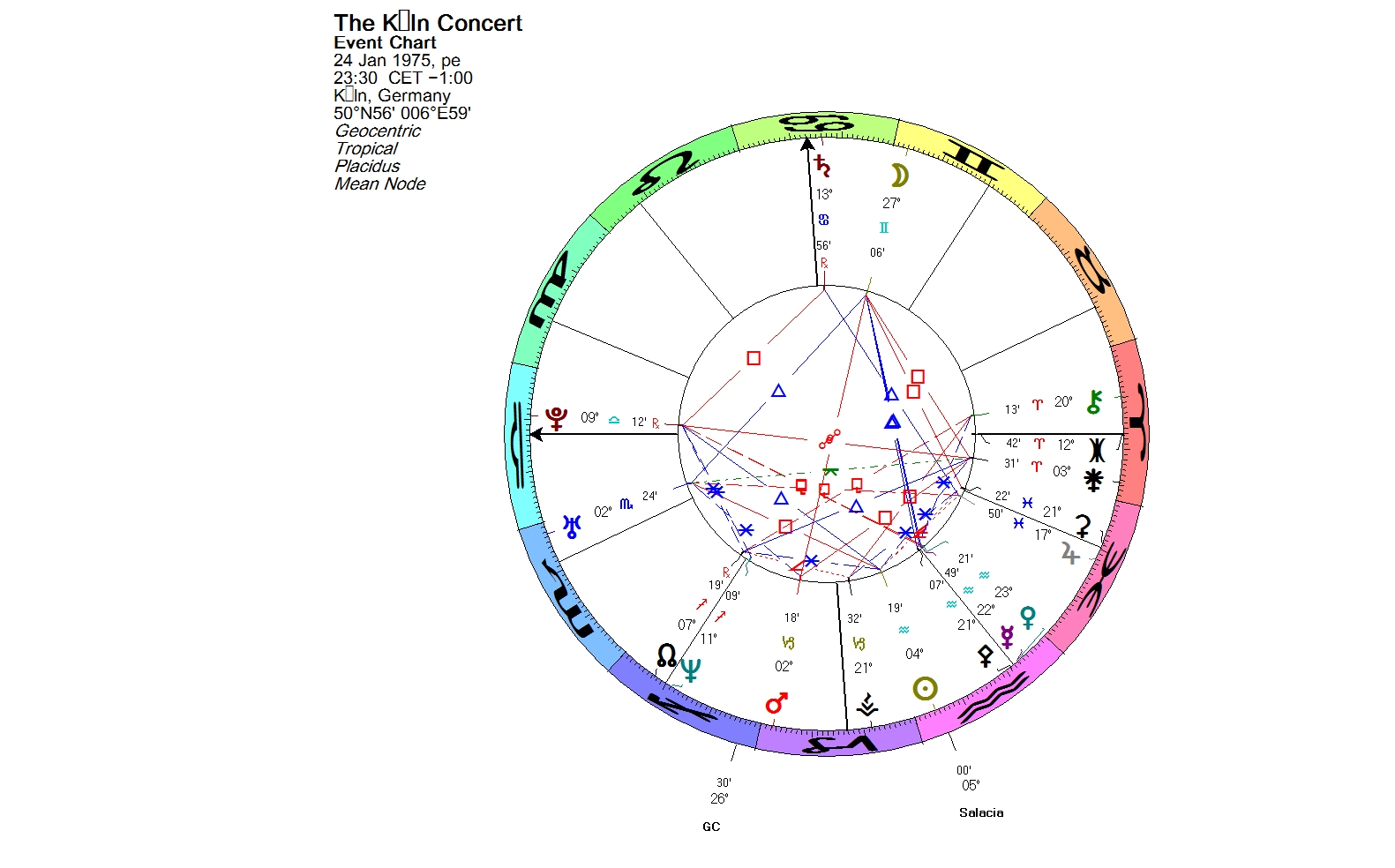
One of the bright moments in history, when the Sun was conjunct Salacia, was on January 24, 1975, when jazz pianist Keith Jarrett performed in Köln and played the solo improvisation, which became known as the Köln Concert. Like the waves in the ocean grow bigger and bigger, Jarrett’s performance originally for a relatively small audience, reached ultimately a huge amount of listeners worldwide. The recording of the concert became the best-selling solo album in jazz history, and the all-time best-selling piano album. Jarrett has told in an interview, that he totally trusted in his imagination while he was playing. The Sun-Salacia conjunction in Aquarius was sextile Jarrett’s Mars in Aries and trine his Neptune in Libra at the time.

Full Moon in Capricorn — June 23, 2013, 11:32 UT

Friday, June 28th, 2013

Summer Solstice – June 21, 2013, 05:04 UT

Full Moon in Capricorn — June 23, 2013, 11:32 UT

“And I’ll find strength in pain
And I will change my ways
I’ll know my name as it’s called again”

– Mumford & Sons, The Cave

There has been a lot of activity lately at the borderline of Gemini and Cancer. Centaur planet Thereus in the last degree of Gemini has been coloring the events of the week.

Thereus has an orbital period of 35 years, and the orbit lies near Saturn. Centaur Thereus in Greek mythology was a hunter, who captured bears and carried them home, alive and struggling.

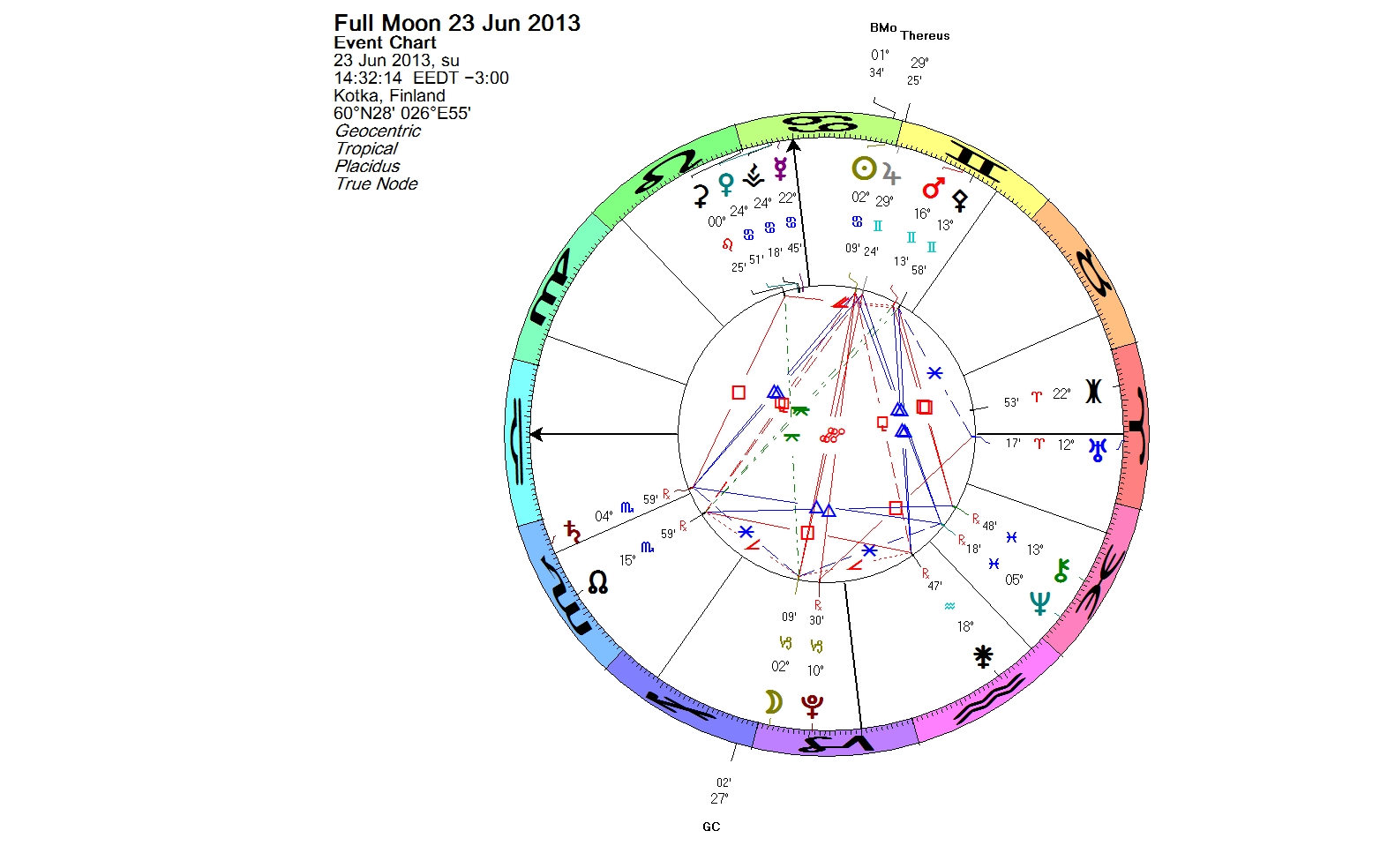
The Sun crossed Thereus on June 20, and entered Cancer the next day, on June 21, which was the longest day of the year in the northern hemisphere, the Summer Solstice. The Solstice was followed by a super Full Moon in Capricorn on June 23. It was the closest and largest Full Moon of the year. A Full Moon is always an opposition of the Sun and the Moon, and this time the alignment took place in the early degrees of Cancer and Capricorn, square the Aries Point. A couple of hours after the exact Full Moon alignment, Jupiter conjoined Thereus in the last degree of Gemini, in conjunction with the Cancer Sun. Thus Thereus was first lit by the Sun and then magnified by Jupiter’s touch.

The Sabian symbol for the Full Moon degree 3 Capricorn is The human soul receptive to growth and understanding. Dane Rudhyar writes about this degree: “What is implied in the position of this symbol seems to be the strong drive in every human consciousness or will toward new experiences, whether they are constructive or destructive. Man may grow and gain understanding and wisdom through both types.”

Like all Centaurs, Thereus has potential for healing and transformation. The Centaurs are related to the shadow, the dark and deep stuff in our psyche. There is no light without the shadow. The healing process is available for us, if only we have the courage to encounter any of our dark issues. It is a continuing process, in which we change and grow. Thereus speaks about this unfolding process. He used to carry snarling bears into his home cave. He didn’t do it only once or twice, it was a habit of his.

On June 26 Jupiter ingressed Cancer, the sign which represents the home. Tomorrow, on June 29, Centaur Thereus follows the Sun and Jupiter to Cancer. In February 2014, due the retrogradation, Thereus briefly revisits Gemini, and in March 2014 enters Cancer again for the second and last time on this round, staying there until July 2017.